Skip to content
Language
Country/region
Search
Cart

Guaiac Wood Perfume – smoky, noble and elegant wood

The heartwood of a sacred South American tree, guaiac offers smoky woody accords, slightly floral and creosote-like, of great natural elegance. A base note prized by the great noses, it brings a unique woody depth that stands apart from cedar and sandalwood. Guaiac wood fragrances, from contemporary woody compositions to grand smoky architectures.

All guaiac wood perfumes

Sort by:
Best selling
Sort by:
Filter and sort Close
Sort by:
Filter by:
  • $00 Product Title 3 colors
  • $00 Product Title 3 colors
  • $00 Product Title 3 colors
  • $00 Product Title 3 colors
  • $00 Product Title 3 colors
  • $00 Product Title 3 colors
  • $00 Product Title 3 colors
  • $00 Product Title 3 colors

Guaiac wood in perfumery: the smoky binder of woody bases

Bulnesia sarmientoi, which is not the true guaiac

One confusion of names is worth clearing up straight away. True botanical guaiac is Guaiacum officinale, a Caribbean tree that once yielded a medicinal resin; perfumery does not use it. What perfumers call guaiac wood is a different species, Bulnesia sarmientoi, a tree of the Gran Chaco straddling Argentina, Paraguay and Bolivia. Its chips and sawdust are steam-distilled, giving a semi-solid essence, almost a paste at room temperature, which has to be warmed before it can be worked. The same wood is also traded as palo santo, which adds to the confusion: the palo santo of South American rituals is a Bursera, an unrelated species. Bulnesia was harvested intensively enough for the species to be listed in CITES Appendix II in 2010, which regulates its trade without banning it.

What does guaiac wood smell like?

Of a dry, smoky wood, with an unexpected floral roundness — people often speak of a rosy facet, and it really is there, like a dusty rose laid on embers. Then comes a tea note and a tarry edge, almost of rope or cold smoke. If you are looking for neighbours, tobacco and vetiver are the ones to call on, not cedar, which is drier and chalkier, nor sandalwood, which is far milkier and softer. On skin, guaiac is tenacious but undemonstrative: it lasts for hours while staying close to the body, and you mostly notice it once it is gone.

Guaiac wood perfumes at Le Soleil d'Or

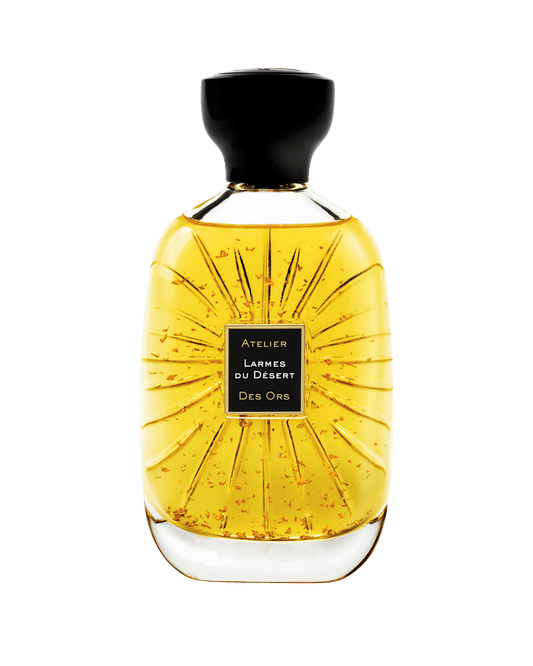
Bois Flotte by Chambre52, composed by Nicolas Beaulieu, is the one where you smell it most distinctly: guaiac gives the dry, salted side of driftwood. Original Vetiver by Creed uses it the other way, as a plinth beneath a vetiver and a cypress that hold the front. Noir By Night by Atelier des Ors, signed by Marie Salamagne, pushes it towards incense and smoke. Palais Bourbon by Memo Paris, composed by Gael Montero, buries it in an amber and vanilla base where it acts as a dry counterweight. And in ALTHAIR by Parfums de Marly, signed by Hamid Merati-Kashani, it is frankly invisible: it holds the vanilla up without showing itself for a second.

Guaiac wood accords and fragrance families

Guaiac plainly belongs to woody perfumes, where it acts as a binder between dry woods and resinous bases. Its smoky facet brings it close to leather perfumes: paired with leather and styrax, it gives those tarry bases that men's perfumery has used for a long time. With incense and patchouli it pulls towards the darker chypre perfumes; with benzoin, vanilla or saffron, towards amber perfumes and oriental perfumes. Its most quoted alliance is with rose and pepper, where its dry smoke keeps the floral from turning into candy. It is finally the natural partner of oud, whose resinous side it extends at far lower cost.

Who is it for, and when?

It is unisex without argument, and one of the easiest notes to wear in a professional setting: it lasts a long time but projects little, which makes it bearable in meetings and on public transport. Its smoky dryness points it towards autumn and winter, where it gains relief on a coat; in summer it stays legible provided it is paired with a citrus or a fresh vetiver. One point of honesty: if you are after a sillage that gets noticed, guaiac is not the way in. It works underneath, giving length and hold to the rest of the formula, and that is precisely why perfumers use it.

How to choose your guaiac wood perfume

Start by accepting one thing: you will not easily find a “guaiac wood perfume” in the way you find a rose or a vanilla perfume. Guaiac is almost always a base ingredient, rarely the subject, and the compositions where it takes the lead can be counted on one hand. The right method is therefore to choose the general direction — smoky woody, leathery, amber, vetiver — and let guaiac do its binding work underneath. Try it on skin and wait at least two hours: this material says nothing on spraying and a great deal by the end of the day. The bespoke discovery box brings together five 2 mL samples composed by hand, each to be worn for a full day. To get your bearings, compare an audible guaiac such as Bois Flotte with a purely structural one such as ALTHAIR: the gap shows exactly what the note does when you cannot pick it out.

Guaiac wood at Le Soleil d'Or, a Lille perfumery since 1953

Founded in 1953 by Jeanne Muyllaert on the Grand'Place in Lille, Le Soleil d'Or is an independent perfumery passed down from one generation to the next. Hubert Maes (third generation) turned it into a reference for niche perfumery; today his daughters Victorine and Apolline Maes (fourth generation) uphold the same standards at 22 rue de la Clef, Lille (59800). Our team will let you smell the guaiac wood perfumes in the catalogue, with expert advice and guided trials, and can point you in the right direction using our guide to fragrance families.

Delivery & free in-store collection in Lille

Within mainland France, Colissimo delivery is free from 49 € to a pickup point and from 79 € to your door. Within Europe, it is free from 90 € to a pickup point and from 120 € to your door; we also ship worldwide. Live in Lille or nearby? Free in-store collection at 22 rue de la Clef is the fastest and most economical option. Full terms on our shipping page.

Frequently asked questions about Guaiac Wood Perfume

What does guaiac wood smell like?

Of a dry, smoky wood, with an unexpected rosy facet, a tea note and a tarry edge. It is closer to tobacco and vetiver than to cedar. On skin it lasts a long time while staying close to the body.

Is perfumery's guaiac wood the true guaiac?

No. True botanical guaiac is Guaiacum officinale, a Caribbean tree that perfumery does not use. The species distilled for perfumes is Bulnesia sarmientoi, a wood from the South American Gran Chaco, which usage ended up calling guaiac. The same wood is also sold as palo santo, unrelated to the Bursera used in rituals.

Are there perfumes built entirely on guaiac wood?

Very few. It is first of all a base material, used as a binder to give hold and a smoky dryness to the whole. In the vast majority of cases it supports a vetiver, a leather, an incense or an amber without ever stepping forward. Looking for a guaiac soliflore leads to disappointment.

Guaiac wood, cedar or sandalwood: what is the difference?

Cedar is dry, chalky, almost knife-cut. Sandalwood is milky, creamy and round. Guaiac sits elsewhere: smoky, slightly tarry, with that rosy roundness that belongs to it alone. Smelled one after the other, the three are not confused.

Does guaiacol come from guaiac wood?

The word does come from guaiac resin, from which the molecule was first isolated. The guaiacol used in perfumery is not extracted from the wood: it is a material in its own right, intensely smoky, also found in peated whisky and smoked meats. It often reinforces the effect of the wood, but they are two distinct ingredients.