Cocoa in perfumery: the bitter bean, not the bar
An absolute of roasted beans
Theobroma cacao is a Central American tree, today grown mainly in Ivory Coast, Ghana, Ecuador and Madagascar. The material travels a long road: the beans are taken from the pod, fermented for several days, dried, then roasted — and it is roasting that creates the smell, exactly as with coffee. The roasted beans are then treated with volatile solvents to obtain a concrete and then a cocoa absolute, brown and pasty, of considerable strength. Worth noting, because the confusion is common: cocoa butter itself has almost no smell and plays no part in fine perfumery.
What does cocoa smell like?
Bitter, dry, powdery, with an earthy and almost dusty facet that surprises anyone expecting confectionery. Cocoa absolute is closer to unsweetened cocoa powder, or even to damp earth, than to a square of chocolate. Its most obvious kinship is with coffee, roasted and bitter in the same way, and with patchouli, whose earthiness it shares — which is why the two blend so naturally. The “chocolate” people think they smell in certain perfumes is not the bean: it is rebuilt on top, with vanilla, milky notes and ethyl maltol, the sweet molecule of caramel and candyfloss. A perfume can therefore smell of cocoa without being gourmand at all, and smell of chocolate without cocoa dominating.
Cocoa perfumes at Le Soleil d'Or
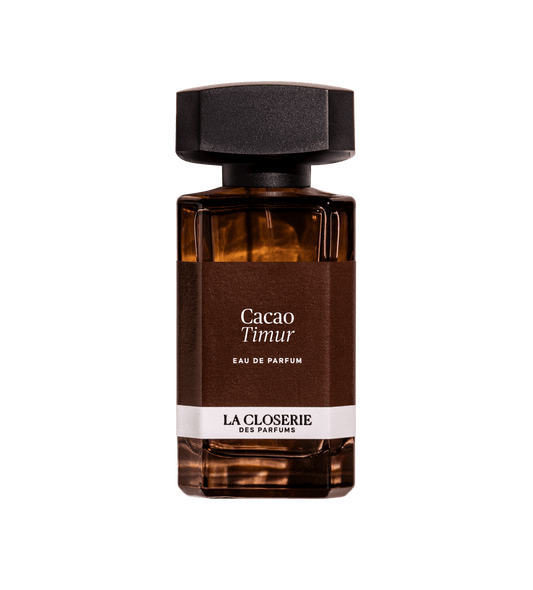
Cocoa Kimiya Extrait by Atelier des Ors, signed by Marie Salamagne, treats cocoa in its dark, dry version, lifted by cardamom and set on patchouli. Dark by Akro, composed by Olivier Cresp, takes the opposite direction: cocoa powder, cinnamon, hazelnut and vanilla — the chocolate reading, fully assumed. Patchouli Mania by Essential Parfums, by Fabrice Pellegrin, uses it as a binder between tea and a woody base. Cacao Pimento by La Closerie des Parfums spices it with chilli and saffron over a base of blond tobacco and immortelle. Finally, Oud Paradisio by BDK Parfums shows that cocoa need not be gourmand at all: the absolute serves as a dark base for an oud and a saffron-tinged rose.
Cocoa accords and fragrance families
Cocoa is filed by reflex under gourmand perfumes, and that holds as soon as it is joined by vanilla, caramel, almond or tonka bean. But its dry nature makes it just as useful elsewhere. With patchouli, vetiver and cedar it builds bitter, grown-up woody perfumes; with coffee and tobacco, roasted bases that tip towards oriental perfumes. Cinnamon, pepper and saffron wake up its bitterness and push it towards spicy perfumes; oud and labdanum draw something dark and resinous from it. It is also an excellent partner for rose, which it darkens without weighing down.
Who is it for, and when?
Cocoa is unisex, and how unisex depends entirely on the treatment: dry and woody, it is worn without reservation; very sweet and milky, it moves towards a more youthful, more demonstrative register. It is a late-autumn and winter note, which comes into its own in the cold and quickly turns stifling in real heat. It lasts a long time, because it lives in the base of a perfume rather than at the top, and it projects: two sprays are usually enough. One word of caution, true of all gourmands: in an office, a shared space or a meeting room, a vanillic cocoa is noticed immediately, whereas a bitter cocoa passes far more easily.
How to choose your cocoa perfume
Start by knowing what you are after: the bitter, powdery cocoa of the bean, or round, sweet chocolate. Both exist, both are written the same way on fragrance pyramids, and the gap between them is wider than the gap between many families. Try it on skin and let an hour go by: cocoa cannot be judged on spraying, it settles. The bespoke discovery box brings together five 2 mL samples composed by hand, each to be worn for a full day. To get your bearings, compare a dark, woody cocoa such as Cocoa Kimiya Extrait with an unapologetically gourmand chocolate such as Dark: after that comparison, you will know which side you are on.
Cocoa at Le Soleil d'Or, a Lille perfumery since 1953
Founded in 1953 by Jeanne Muyllaert on the Grand'Place in Lille, Le Soleil d'Or is an independent perfumery passed down from one generation to the next. Hubert Maes (third generation) turned it into a reference for niche perfumery; today his daughters Victorine and Apolline Maes (fourth generation) uphold the same standards at 22 rue de la Clef, Lille (59800). Our team will let you smell the cocoa perfumes in the catalogue, with expert advice and guided trials, and can point you in the right direction using our guide to fragrance families.
Delivery & free in-store collection in Lille
Within mainland France, Colissimo delivery is free from 49 € to a pickup point and from 79 € to your door. Within Europe, it is free from 90 € to a pickup point and from 120 € to your door; we also ship worldwide. Live in Lille or nearby? Free in-store collection at 22 rue de la Clef is the fastest and most economical option. Full terms on our shipping page.