Incense in perfumery: frankincense, between freshness and smoke
A resin harvested by cutting into the bark
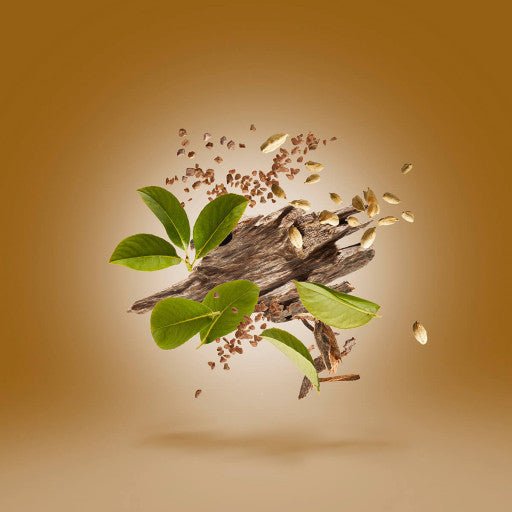
The incense of perfumery has a more precise name: frankincense, the gum resin of trees of the genus Boswellia, mainly Boswellia sacra and Boswellia carterii, which grow in Oman, Yemen, Somalia and Ethiopia on arid ground where almost nothing else holds. The bark is cut, the tree exudes a milky sap, and that sap hardens in the air over a few weeks into amber tears that are gathered by hand. The operation is repeated several times a season on the same tree, and that is exactly where the problem lies: demand has led to tapping that is too frequent, exhausting the stands and compromising their regeneration. Perfumery steam-distils these tears into an essence, or treats them with solvent for a darker, more balsamic resinoid. None of this concerns myrrh, which is another resin, from another botanical genus, Commiphora.
What does incense smell like?
That depends entirely on the form used, and it is the source of every misunderstanding. The distilled essence is fresh: lemony, turpentine-like, peppery, almost green, with a mineral clarity that surprises anyone expecting smoke. The smoke only appears when the resin burns — what you smell then is a combustion product, warm, balsamic, faintly sweet, and no essence reproduces it exactly; perfumers rebuild it with smoky materials, with cistus, labdanum or styrax. The resinoid sits between the two. Compared with its neighbours, incense is drier and clearer than benzoin, less bitter and less medicinal than myrrh, less animalic than oud. On skin it lasts a long time and stays perceptible on clothing well after a shower.
Incense perfumes at Le Soleil d'Or
La Liturgie des Heures by Jovoy, signed by Jacques Flori, takes the liturgical reference all the way: cypress, frankincense, cistus and myrrh, a censing reconstructed as such. At the exact opposite, Encens Suave by Matiere Premiere melts the resin into coffee, Madagascar vanilla and benzoin, turning it into something round and gourmand. Bois d'Ascese by Naomi Goodsir, composed by Julien Rasquinet, pushes it towards wood fire and whisky, while Iris Cendre, from the same house, uses it as a smoky veil over a powdery iris. More contemplative, Mauna by Mendittorosa, signed by Cristiano Canali, uses it as a veil laid over a milky sandalwood.
Incense accords and fragrance families
Incense is one of the backbones of oriental perfumes and amber perfumes, where it joins the other resins — myrrh, benzoin, labdanum — to build those warm, enveloping bases. Its dry facet makes it just as natural in woody perfumes, over a cedar, a sandalwood or an oud. With leather and tobacco it gives dark, textured compositions; with iris and saffron, powdery, cold accords. Its most contemporary reading lies elsewhere: set beneath a bergamot or a pepper, it pulls aromatic perfumes towards the mineral without weighing them down.
Who is it for, and when?
Incense is unisex beyond argument, and it is probably the note where gender matters least. It does ask for a little conviction, though: the liturgical reference is so ingrained that some people never manage to separate it from church, and a smoky incense worn into a meeting produces an effect you have to actually want. Autumn and winter suit it better, the cold tempering what heat would make stifling; the clear, lemony readings, on the other hand, work very well in summer. One practical point: incense is among the most tenacious notes on the palette, and compositions that use it in the base stay legible for twelve hours. Three sprays are better than six.
How to choose your incense perfume
The first question to settle is the one about smoke: are you after fresh, lemony, mineral incense, or burnt incense, warm and a little dark? A great many disappointments start there, because the label never says. Try it on skin and let two hours pass, long enough for the base resins to settle — that is where the matter is decided. The bespoke discovery box brings together five 2 mL samples composed by hand, each to be worn for a full day. To get your bearings, compare an openly liturgical incense such as La Liturgie des Heures with an incense melted into gourmand warmth such as Encens Suave. The gap shows clearly how much the word covers.
Incense at Le Soleil d'Or, a Lille perfumery since 1953
Founded in 1953 by Jeanne Muyllaert on the Grand'Place in Lille, Le Soleil d'Or is an independent perfumery passed down from one generation to the next. Hubert Maes (third generation) turned it into a reference for niche perfumery; today his daughters Victorine and Apolline Maes (fourth generation) uphold the same standards at 22 rue de la Clef, Lille (59800). Our team will let you smell the incense perfumes in the catalogue, with expert advice and guided trials, and can point you in the right direction using our guide to fragrance families.
Delivery & free in-store collection in Lille
Within mainland France, Colissimo delivery is free from 49 € to a pickup point and from 79 € to your door. Within Europe, it is free from 90 € to a pickup point and from 120 € to your door; we also ship worldwide. Live in Lille or nearby? Free in-store collection at 22 rue de la Clef is the fastest and most economical option. Full terms on our shipping page.